
NHP Arrests Across Nevada Commands
The Highway Patrol is the statewide patrol division inside Nevada's Department of Public Safety. Troopers enforce traffic law. They work roadway incidents and handle criminal matters that surface during a stop. Impaired-driving crackdowns, warrant arrests, and investigations all start on the shoulder of a highway. NHP runs no jail of its own. There is no single statewide booking roster either. Once a trooper makes an arrest, custody changes hands. It passes to whatever local detention system serves that stretch of road.
NHP's official history page traces the patrol back to its 1949 organization. Patrol coverage now splits across three commands. Northern Command West covers Reno and its neighboring communities. Northern Command East watches the Elko area and the northeastern routes. Southern Command handles the Las Vegas region. Remember that these are patrol zones, not separate custody databases. A booking search works best by location. Follow the arrest to the county or city jail that received the person.
The Northern Command information lays out the Reno and Elko operating areas. It also maps their substations. Knowing the command can point you toward the right NHP office or release. It will not tell you which jail holds someone now. That answer depends on where the arrest happened and where custody was transferred.
| Command | Research-confirmed area | Lookup implication |
|---|---|---|
| Northern Command West | Reno-area coverage | Check the local jail system that accepted the booking. |
| Northern Command East | Elko-area coverage | Use the receiving county or municipal custody source. |
| Southern Command | Las Vegas region | Route to the detention system serving the arrest location. |
Where NHP Arrest News Appears
News about NHP arrests travels along several official channels rather than one feed. NHP Media serves as the front door. It handles press contacts, traffic updates, enforcement announcements, and selected incident releases. Posts there cover events the agency chose to share publicly. They are not an arrest list. The DPS Media and Public Relations page offers wider public-safety announcements. The Nevada Joint Information Center archive adds more of the same.
For current accounts, the DPS social-media directory links to every department channel, NHP included. A post can be brief, delayed, or corrected. That happens while an investigation stays active. Treat each one as an agency announcement rather than a custody list.
| Official channel | Useful for | What it does not provide |
|---|---|---|
| NHP Media | Selected incidents, road hazards, enforcement news, and media contacts | A complete daily arrest or dispatch log |
| Joint Information Center | Coordinated public-safety alerts and releases | Every NHP booking record |
| DPS social accounts | Agency-posted updates and safety notices | Continuous custody status |
NHP Media provides the Highway Patrol’s public news route and current media contacts.
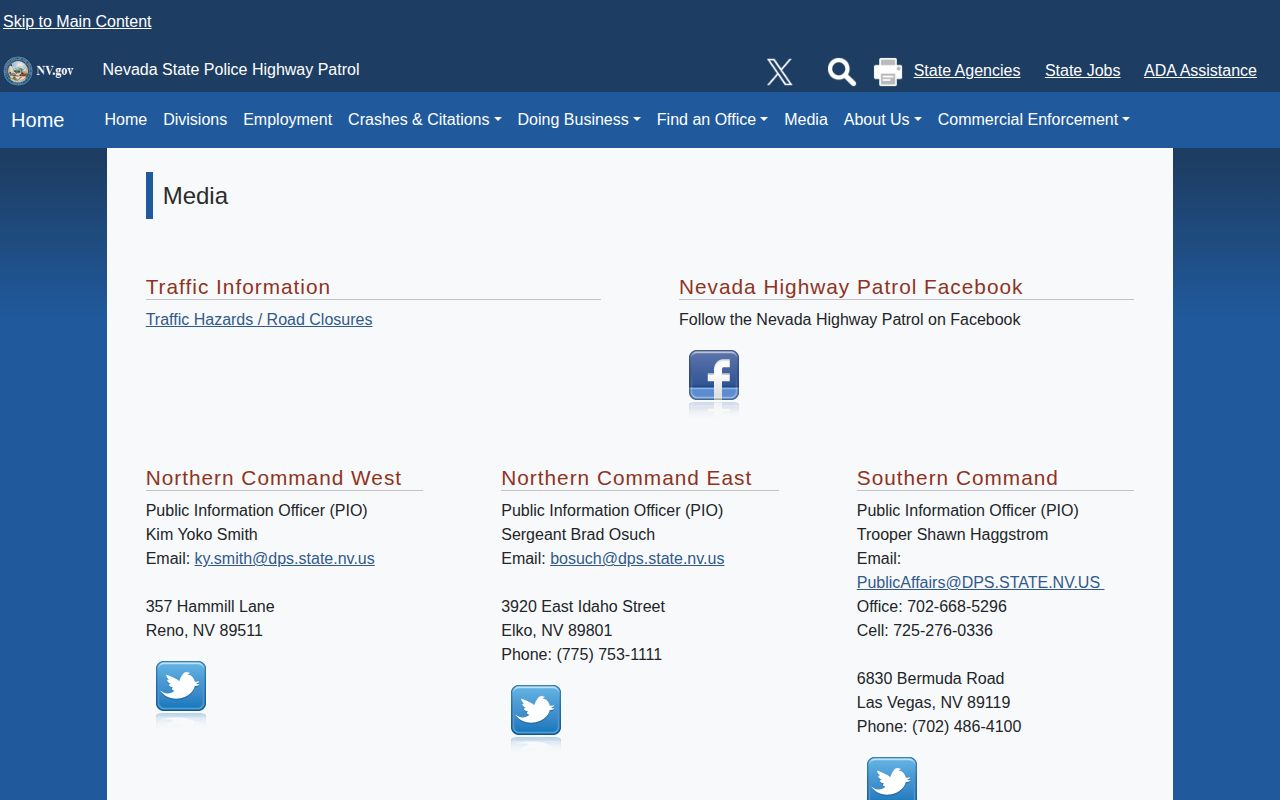
NHP Media is simply the agency's chosen publishing route. A name missing from that page proves nothing about whether an arrest happened.
Nevada Has No Public NHP Arrest Log
NHP and DPS publish no official daily arrest or dispatch log. That gap matters when you are trying to confirm one specific booking. A press release exists because an agency picked it for public communication. A custody roster exists because the receiving jail built it. They answer different questions and update on different clocks.
The Joint Information Center coordinates alerts and media information. It is not an NHP booking feed. Social posts lean toward roadway hazards, safety campaigns, big incidents, and chosen enforcement activity. Plenty of arrests get no post at all. Even a posted incident may leave names out.
Use the news channel to see what the agency announced. Use the jail roster to check local custody. File a records request for the report itself. An empty NHP media search proves nothing. It cannot show that nobody was arrested, released, or charged in court.
How to Check an NHP Arrest
Match your search to the question. News releases cover selected events. A custody search shows whether someone sits in the receiving jail's current system. A post or roster is not always enough. A report request then reaches the underlying agency record. The three routes pull from separate stages, so their answers can differ.
- Look at NHP Media or a DPS public alert for a selected announcement. Record the incident date and location.
- Identify the county or city detention system that took custody. Search that system by name or booking details if available.
- Use the Nevada County Directory to reach the relevant local source; compare dated feeds with current-custody results.
- If the record is not online, submit a focused request to DPS or the agency that created the specific document.
The statewide Arrested Today overview explains county booking timing. Each county system posts a new booking at its own time. A current roster shifts as people get released or transferred. A dated announcement stays searchable as news. Use each tool for its own purpose. Then turn to court records for filed charges and outcomes.
Start narrow. A date range plus a likely arrest county beats typing one name into every system. The agency is not always clear. In that case, the incident location and any public report can point you toward the NHP command or local department involved. Every portal has its own search fields, and some reject identifiers others accept.
Where NHP Arrestees Are Booked
NHP makes the arrest but never holds the booking entry. A trooper's arrestee usually goes elsewhere. The person is booked into the county or municipal detention system serving the arrest location or receiving jurisdiction. That local system creates the booking record and sets its own roster and photo policy. So the records can sit apart. A state-police news item and a jail booking entry can appear on separate websites, hours or days apart.
New NHP arrestees are booked nearby. Search the receiving county or city jail first. NDOC's Offender Search covers the state-prison layer, never fresh county bookings.
Someone released or transferred may drop off a live roster. The booking record itself usually survives. Ask that agency's records process for it directly. A missing entry is not proof of release, so confirm custody with the jail.
Request a Nevada NHP Arrest Report
DPS holds incident and arrest records. Start at the DPS public-records page. It connects to the online GovQA portal and a paper option under Nevada's Public Records Act. Name the agency and the event. Say whether you want to inspect the file or receive a copy.
- Give a name and reliable contact details for the requester.
- Provide the incident date or a narrow date range, the location, and a detailed description of the arrest or event.
- Say whether inspection or copies are wanted, the preferred format, and how the response should be delivered.
- Review the response for any estimate, redaction, or clarification request. DPS generally charges actual costs; a request using more than two staff hours may trigger an extraordinary staff-use charge.
DPS public-records instructions show the department’s online and paper request routes.
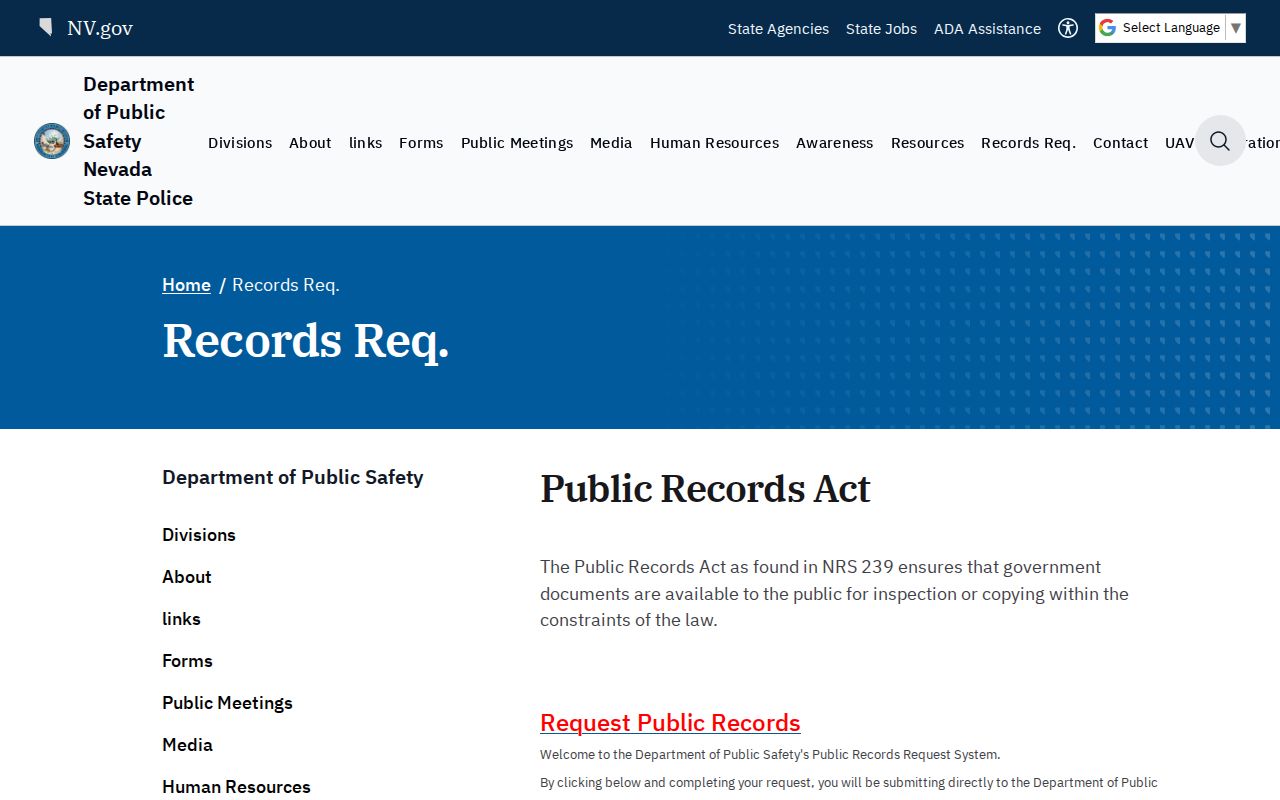
The DPS page is the starting point for department-held material. Under NRS 239.0107, an agency generally must respond within five business days by providing access, giving an estimate, or explaining why the record is not available; that is not a guarantee that a complex file will be complete by then.
The DPS request page lists the Public Records Official and paper-submission details. Include a date, place, and report type when writing or calling. An arrest record may contain private, juvenile, victim, medical, or investigative details that must be withheld or redacted under law.
Describe the document rather than asking for an entire person’s history. For example, identify the incident, approximate date, location, and known arresting agency, then say whether the request seeks a report, a dispatch record, or another specific item. If inspection is acceptable instead of copies, state that preference. DPS may ask for clarification when a description could match several records.
The fifth-business-day rule is a response duty, not a delivery clock. Staff may provide an estimate, arrange inspection, or explain a legal basis for withholding. A complex request can take longer, and a record may arrive with redactions. Keep the request confirmation and any correspondence so a follow-up can refer to the same request number and scope.
NHP Crash Reports Use a Separate Route
Crash reports travel a different route than arrest records. NHP's Crash Report Request page links to CrashDocs for the lookup. You'll need the NHP crash number, a last name, and the crash date. Reports are usually ready in seven to fourteen days. Each report costs $10. Fatal reports and requests for all crash photographs go through the regional office instead. Photos are listed at $5. The NHP crash-report page spells out the keys, cost, timing, and office path.
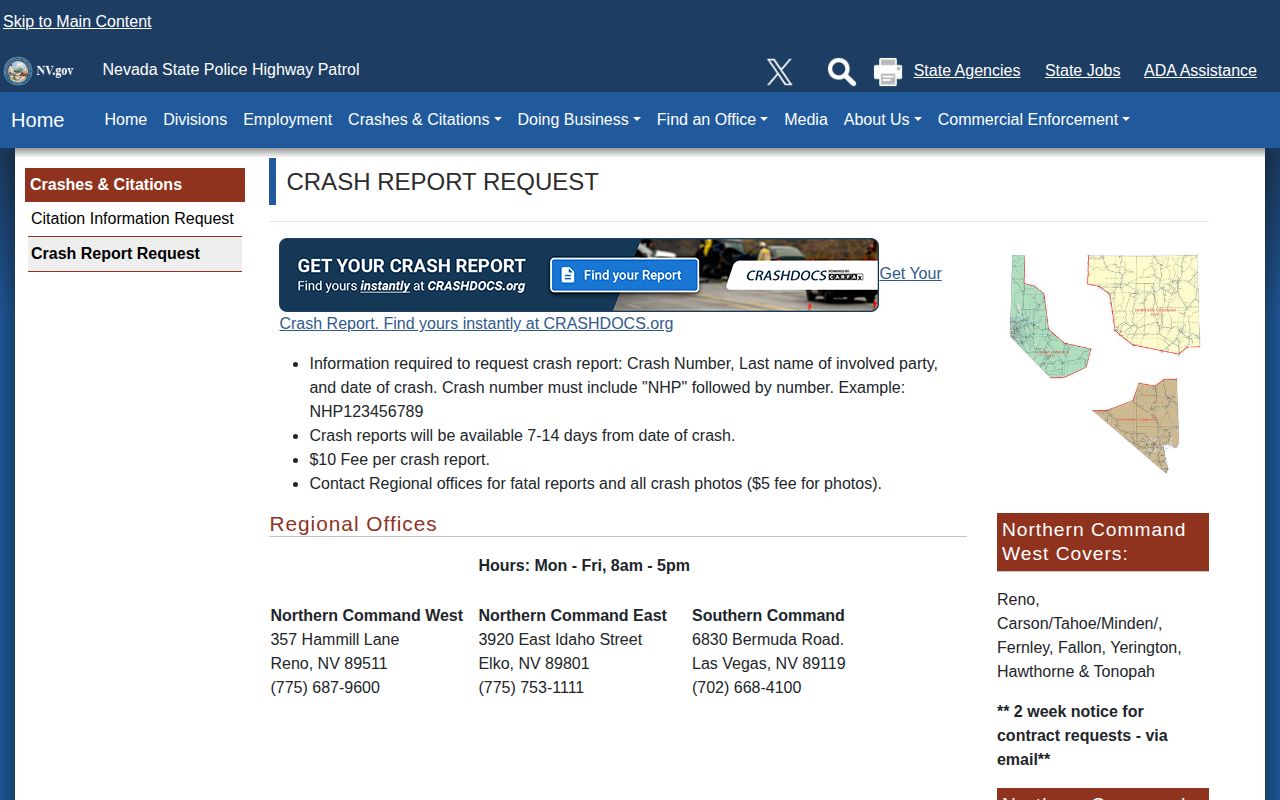
That form is for collisions, not arrests. A crash report won't cover the arrest side. If one event includes both, file a separate DPS public-records request for the arrest or incident document and explain how the records relate.
| Crash-record item | Published detail |
|---|---|
| Online lookup | CrashDocs, using the NHP crash number, last name, and date |
| Report timing | Generally 7–14 days |
| Report fee | $10 per report |
| Crash photographs | $5; fatal reports and all-photo requests go through a regional office |
Those regional phone contacts belong to the crash-report process. They are not general arrest-record numbers.
| Crash-report region | Telephone |
|---|---|
| Las Vegas | 702-668-4100 |
| Reno | 775-687-9600 |
| Elko | 775-753-1111 |
Nevada DUI Arrests and Patrol Results
Nevada's Office of Traffic Safety publishes a yearly report on funded traffic-safety work. The 2024 annual report and the 2023 annual report describe grant-backed DUI activity, saturation patrols, stops, citations, and arrests across NHP commands. Those totals show enforcement at a statewide scale. They name no one arrested. Campaign numbers cannot replace a booking lookup. They explain why one region sees a month of focused DUI enforcement while another does not, but they stay aggregate. No report of this kind lists a person's booking number, jail status, or charge history. Never infer bookings from a campaign total. Individual arrestees stay out of view. For one person's case, split the task. Use the local jail record for custody. Use DPS or NHP for the incident report. Turn to the court record for filed charges and the recorded outcome. A booking charge can change later. News roundups are another matter. Selected releases are not a complete blotter. Local logs and coverage vary widely across Nevada. Weekend or multi-day stories can help you locate an event, but no statewide news archive equals a full NHP booking ledger. One more distinction matters here. An NHP incident report is not a criminal-history record from Nevada's Central Repository. NRS Chapter 179A governs how criminal-history information is released. A single traffic-stop request builds no one's full history. Keep the event, custody, criminal-history, and court paths separate when you confirm a timeline.